Inference Platform
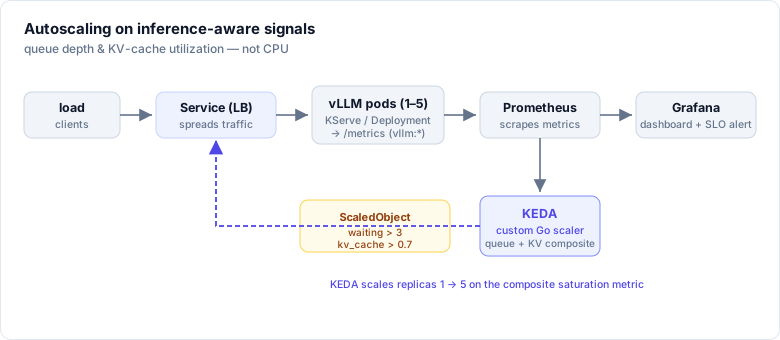
An autoscaling LLM inference platform on Kubernetes that scales vLLM on inference-aware signals — request-queue depth and KV-cache utilization, not CPU — through a custom KEDA external scaler, validated on a DIY two-GPU cluster with real vLLM serving.
Highlights
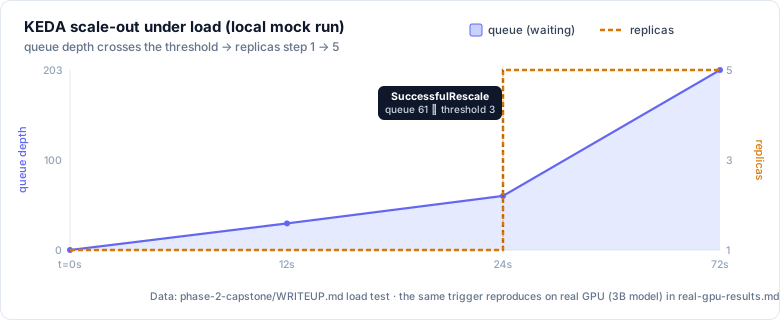
- Autoscaling reacts to the right signal. Under load, KEDA scaled the serving Deployment 1 → 5 replicas on queue depth; routing traffic through a load balancer is what actually put the new replicas to work. → capstone write-up
- Real two-GPU vLLM. Qwen2.5-1.5B sustains ~2,600 tok/s (compute-bound); the 3B model's smaller KV pool trips the KV-cache/queue trigger — the regime flip that inference-aware scaling is built for. → real-GPU results
- A custom Go KEDA external scaler on a composite queue-depth + KV-cache saturation metric, built and unit-tested in CI. → the scaler
This began as self-directed, hands-on depth in LLM inference serving — the platform layer that sits underneath generative AI models: GPU scheduling, high-throughput serving engines, inference-aware autoscaling, and the observability and economics of running models at scale. It's organized in two tracks: a literacy track (vocabulary and measured local serving) and a build track (the autoscaling platform above).
What is AI inference?
Inference is the serving phase of a model's lifecycle. You take an already-trained model and run it to produce outputs in response to live requests. It is the counterpart to training: training builds the model's weights, and inference uses those weights to generate tokens for users. Every time you send a prompt to a chatbot, a coding assistant, or any generative AI product, you trigger an inference request.
For a large language model, a single request runs in two distinct phases:
- Prefill is the first forward pass. It processes the entire input prompt and produces the first output token. It is compute-bound, so the work scales with prompt length and saturates GPU compute (FLOPs).
- Decode is the token-by-token generation that follows. It is memory-bandwidth-bound, so each new token depends on the growing KV cache rather than raw compute.
Why it matters
- It is where the cost lives. A model is trained once but served billions of times. GPUs are the dominant cost, so the unit economic that matters is cost-per-million-tokens, driven by utilization, batching, and quantization.
- It is where the user experience lives. Latency signals like time-to-first-token (TTFT) and tokens-per-second directly shape how a product feels. The serving layer, not the model weights, decides whether responses feel instant or sluggish.
- It scales differently from normal infrastructure. CPU utilization is nearly meaningless for GPU inference. The real saturation signals are KV-cache pressure, queue depth, and tail latency, which is why inference needs autoscaling built around those signals instead of the CPU-based autoscaling most platforms use.
What's here
| Section | What it covers |
|---|---|
| Glossary | The inference-serving vocabulary: request lifecycle, batching, metrics, engines, autoscaling. |
| Phase 1 — Foundations | Serving a model locally and measuring TTFT and throughput, with a written brief on how serving works and why it is hard. |
| Phase 2 — Capstone | Building an autoscaling LLM inference platform on Kubernetes (KServe + vLLM + KEDA + Prometheus/Grafana). |
| Resources | Curated papers, books, blogs, podcasts, and videos on LLM inference serving. |
Start with the Glossary for the vocabulary, then the Phase 1 results for measured behavior on real hardware.